1. What is the Stock Market, and How Does it Function?
The stock market is a platform where shares of publicly listed companies are bought and sold. It plays a crucial role in the economy by enabling companies to raise capital and providing investors an opportunity to earn returns on their investments.
$$ \text{DCF Value} = \sum_{t=1}^{n} \frac{\text{FCF}_t}{(1 + r)^t} + \frac{\text{TV}}{(1 + r)^n} $$
How the Stock Market Works
The stock market functions through stock exchanges, where buyers and sellers trade stocks electronically.
In India, the two major exchanges are:
- Bombay Stock Exchange (BSE)
- National Stock Exchange (NSE)
Understanding the Stock Market
The stock market is a financial marketplace where individuals and institutions buy and sell shares of publicly listed companies. It acts as a bridge between companies and investors, allowing businesses to raise capital and investors to participate in wealth creation.
Unlike traditional markets, the stock market operates electronically through trading platforms, where transactions are matched between buyers and sellers. The prices of stocks are determined by demand and supply:
- If more people want to buy a stock, its price increases.
- If more people want to sell, the price falls.
Key Components of the Stock Market
- Stock Exchanges – Platforms where shares are listed and traded (e.g., NSE & BSE in India).
- Regulatory Bodies – Organizations like SEBI that oversee and regulate market activities.
- Stockbrokers – Licensed intermediaries who facilitate trades between investors and exchanges.
- Companies (Issuers) – Businesses that issue shares to raise capital.
- Investors & Traders – Individuals or institutions who buy/sell shares for investment or trading purposes.
How Does the Stock Market Function?
The stock market functions through a structured process where buyers and sellers interact via stock exchanges:
1.Company Listing (IPO) – A company lists its shares in an Initial Public Offering (IPO) to raise funds.
- Buying & Selling Stocks – Investors place buy/sell orders through brokers.
- Price Determination – Stock prices fluctuate based on supply & demand dynamics.
- Trade Execution – The exchange matches buy/sell orders and executes the trade.
- Settlement Process – Shares and money are transferred between buyers and sellers through **T+1 settlement
Example of Price Fluctuation Based on Demand & Supply
| Scenario | Demand | Supply | Price Impact |
|---|---|---|---|
| More buyers than sellers | High | Low | Stock price goes up |
| More sellers than buyers | Low | High | Stock price goes down |
Stock Market Index: Measuring Market Performance
A stock market index tracks the overall performance of the market. Major indices include:
- NIFTY 50 – Tracks the top 50 stocks on NSE.
- SENSEX – Tracks the top 30 stocks on BSE.
These indices help investors analyze the overall market sentiment.
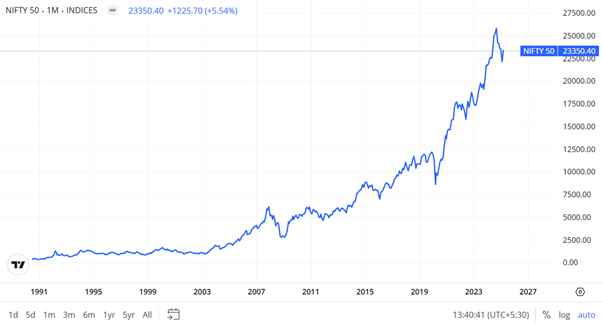
NIFTY 50 Historical Performance
How Do Stock Prices Change?
Stock prices fluctuate due to demand and supply — higher demand raises prices, while higher supply lowers them.
Key Factors Influencing Stock Prices
- Company Performance – Strong earnings attract buyers, pushing prices up.
- Market Sentiment – News, policies, and global events impact investor behavior.
- Economic Indicators – Inflation, GDP growth, and interest rates affect stock valuations.
- FII & DII Flows – Foreign and domestic institutional investments influence demand.
- Sectoral Trends – Industries perform differently based on market cycles.
- Liquidity & Supply – Stocks with low trading volumes are more volatile.
Example
| Event | Demand Impact | Price Effect |
|---|---|---|
| Strong earnings | Increases | Price rises |
| Interest rate hike | Decreases | Price drops |
| FII buying | Increases | Surges |
| Global crisis | Decreases | Falls |
Stock Market Example: How a Trade Happens
Let’s assume you want to buy 10 shares of Reliance Industries at ₹2,500 per share:
- You log in to ATS trading platform and place a buy order for 10 shares.
- ATS sends your order to the stock exchange.
- The exchange matches your order with a seller willing to sell at ₹2,500.
- Once matched, the trade is executed, and the shares are transferred to your Demat account.
- The transaction is settled in T+1 day meaning the money is deducted from your account and shares are credited.
Key Takeaways
- The stock market is a platform for buying and selling shares of publicly listed companies.
- It consists of the primary market (for IPOs) and the secondary market (for daily trading).
- Stock prices fluctuate based on demand, supply, company performance, and economic factors.
- Investors, brokers, regulators, and companies are key market participants.
- Long-term investment in the stock market has historically yielded significant returns.