3. What are the Key Components of a Futures Contract?
Futures contracts are standardized trading instruments that allow participants to buy or sell an asset at a predetermined price on a future date. These contracts are carefully structured by the exchange to ensure transparency, uniformity, and risk control.
To trade futures effectively, it’s essential to understand the key components that define every contract. Each component plays a role in how the contract behaves in the market and impacts a trader’s strategy, risk, and returns.
1. Underlying Asset
This is the base asset that the futures contract derives its value from. It could be:
- A stock (e.g., Reliance, TCS)
- A stock index (e.g., Nifty 50, Bank Nifty)
- A commodity (e.g., gold, crude oil)
- A currency pair (e.g., USDINR, EURINR)
The price of the futures contract moves based on the spot price (current market price) of this asset.
2. Contract Size (Lot Size)
This defines the quantity of the underlying asset covered by a single futures contract. The lot size is fixed by the exchange.
Examples:
- Nifty Futures Lot Size = 50 units
- Reliance Futures Lot Size = 250 shares
- Crude Oil Futures Lot Size = 100 barrels
The lot size determines the capital required and the profit or loss per point movement.
3. Expiry Date
Futures contracts have a limited life. On NSE, monthly equity-derivative contracts expire on the last Tuesday of the month.
After this date, the contract becomes invalid, and positions must either be:
- Closed (squared off)
- Rolled over to the next month
- Settled (physically or in cash)
4. Tick Size
The tick size is the minimum price movement allowed in the contract.
Example:
- Nifty Futures tick size = 0.05 points
- If Nifty moves from 22,000 to 22,000.05, that’s one tick.
Each tick represents a small monetary change, which when multiplied by the lot size determines the gain or loss for that movement.
5. Margin Requirement
You don’t need to pay the full value of the contract. Instead, you deposit a percentage of the total value as margin—this allows leverage.
Margins are usually between 5% to 15% of the contract value and include:
- Initial Margin: Required to enter the trade
- Maintenance/Exposure Margin: Required to keep the position open
- Mark-to-Market (MTM): Daily settlement of gains/losses
6. Settlement Type
Futures contracts can be settled in two ways:
- Cash Settlement: Only the difference in price is paid or received.
- Physical Settlement: The underlying asset is actually delivered (as in the case of stock futures in India now).
The type of settlement depends on the asset and exchange rules.
7. Contract Value
This is the total value of the futures position.
Contract Value = Lot Size x Future Price
Example:
- Nifty Futures at ₹22,000 with lot size 50
- Contract Value = 22,000 × 50 = ₹11,00,000
- Margin (10%) = ₹1,10,000 approx.
8. Mark-to-Market (MTM)
This refers to the daily settlement of gains or losses based on the current market price of the contract.
- If the futures price rises in your favor → Profit is credited
- If it moves against you → Loss is debited
MTM ensures that positions are regularly adjusted, and traders must maintain enough balance to avoid a margin call.
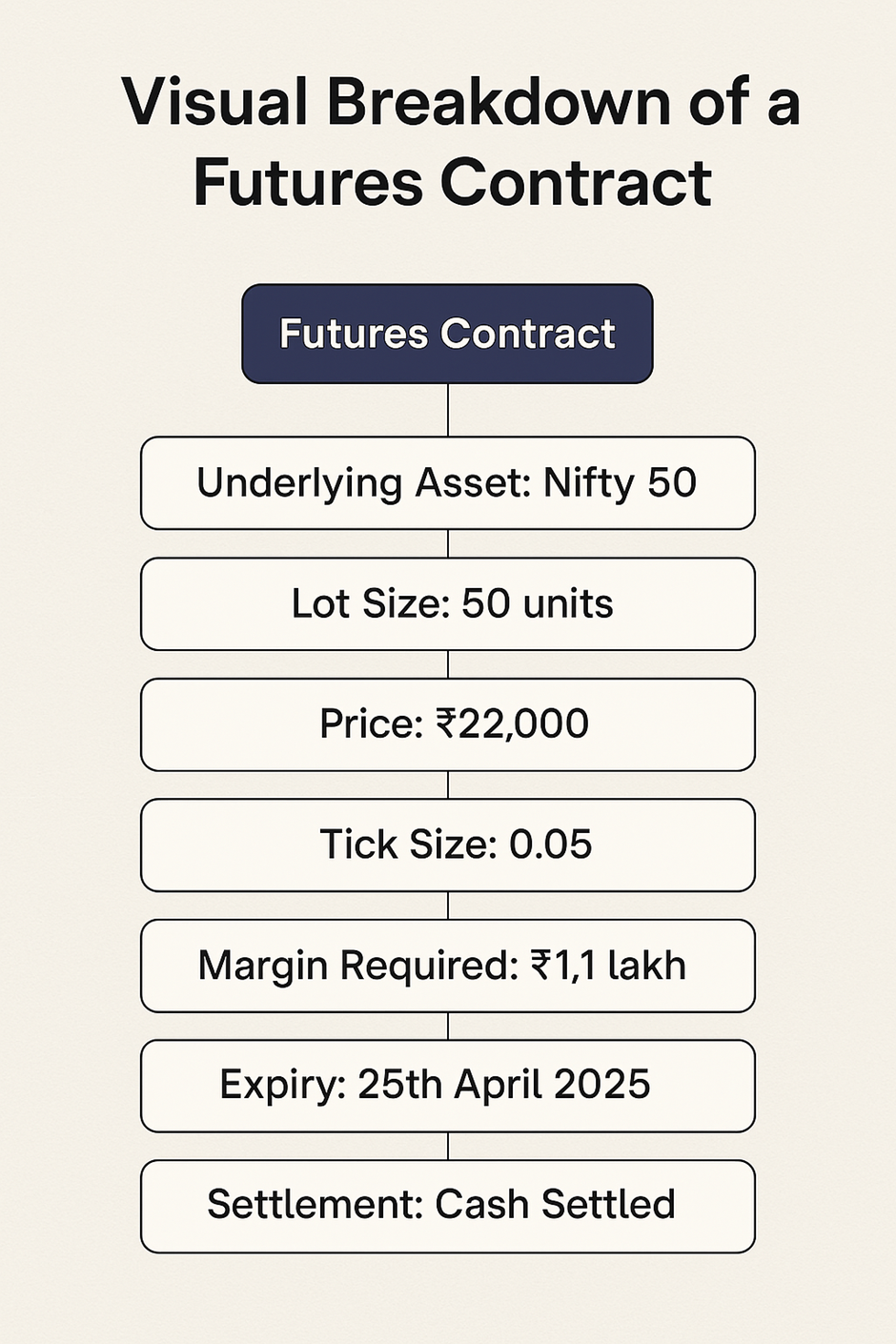
Example: Nifty Futures Contract Breakdown
| Component | Value |
|---|---|
| Underlying Asset | Nifty 50 Index |
| Lot Size | 50 units |
| Tick Size | 0.05 |
| Expiry Date | Last Tuesday of the month on NSE |
| Futures Price | ₹22,000 |
| Margin Required | ~₹1,10,000 (10%) |
| Settlement | Cash settled |
Key Takeaways
- A futures contract is a bundle of defined parameters that determine how it trades, expires, and settles.
- Traders should understand each component before entering a position, as it affects risk, returns, capital requirement, and strategy.
- Knowing your contract details helps in position sizing, risk management, and execution timing.