What is Meant by "At the Money" (ATM) in Options?
In options trading, an option is considered At the Money (ATM) when the strike price of the option is equal to or very close to the current market price (spot price) of the underlying asset.
It is the point where the option has no intrinsic value, and the entire premium consists of time value. This is a critical zone because the option is on the threshold of profitability but has not yet achieved any gain if exercised.
1. Technical Definition
- A Call Option is ATM when:
Spot Price = Strike Price
- A Put Option is ATM when:
Spot Price = Strike Price
In both cases, the intrinsic value is zero because exercising the option would neither result in profit nor loss.
2. Example Table
| Option Type | Strike Price | Spot Price | Intrinsic Value | Status |
|---|---|---|---|---|
| Call | ₹1,000 | ₹1,000 | ₹0 | At the Money |
| Put | ₹1,000 | ₹1,000 | ₹0 | At the Money |
3. Why is "At the Money" Important?
- ATM options have the highest time value
- These options are usually more liquid and widely traded
- They are favoured in strategies like straddles, strangles, and gamma scalping, which rely on sharp movements in the underlying asset
- As time progresses, ATM options quickly turn into either In the Money (ITM) or Out of the Money (OTM), depending on the direction of the underlying asset's price movement
4. Visual Representation of Moneyness
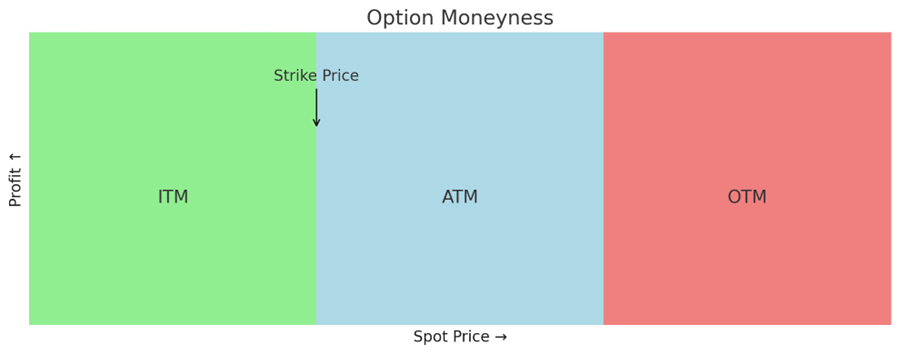
- In the Money (ITM): The option is already profitable if exercised
- At the Money (ATM): The option is break-even
- Out of the Money (OTM): The option is not profitable
5. Real-Life Analogy
Imagine a game where both teams are tied. There is no winner or loser at that moment. The game could go either way depending on the next move. Similarly, an ATM option is at a tipping point — neither profitable nor worthless. The next movement in the underlying asset will decide its fate.
6. Option Premium Breakdown at ATM
ATM options do not have intrinsic value, so the entire premium is based on time value and implied volatility.
| Option Type | Premium | Intrinsic Value | Time Value |
|---|---|---|---|
| ATM Call | ₹40 | ₹0 | ₹40 |
| ATM Put | ₹35 | ₹0 | ₹35 |
As the option nears expiry, this time value rapidly decreases. This is known as theta decay.
7. ATM vs ITM vs OTM – Comparative Table
| Moneyness | Spot vs Strike | Intrinsic Value | Time Value | Risk Level |
|---|---|---|---|---|
| In the Money | Spot > Strike (Call), Spot < Strike (Put) | Present | Present | Lower |
| At the Money | Spot = Strike | None | Present | Moderate |
| Out of the Money | Spot < Strike (Call), Spot > Strike (Put) | None | Present | Higher |
8. Key Takeaways
- An option is considered At the Money when the strike price is equal to the spot price of the underlying asset
- ATM options have no intrinsic value; their entire premium is made up of time value
- These options are highly liquid and widely used in volatility-based trading strategies
- As the option approaches expiry, the premium declines rapidly due to time decay
- ATM options are positioned at the threshold between profit and loss, making them highly sensitive to small price movements in the underlying asset