5. What is the Strike Price in Options?
A strike price (also called the exercise price) is one of the most important components of any options contract. Whether you're buying a call or a put, the strike price defines the pre-agreed level at which you can buy or sell the underlying asset.
Definition
The strike price is the price at which:
- A Call Option holder has the right to buy the asset.
- A Put Option holder has the right to sell the asset.
This price is fixed at the time of entering the contract and stays unchanged until expiry.
Why Does Strike Price Matter?
The strike price:
- Determines whether the option is profitable (in-the-money).
- Is a critical factor in calculating the option premium.
- Helps define the breakeven point for the trade.
- Acts as the base for deciding whether to exercise or let the option expire.
In short, it separates potential profit from certain loss.
Strike Price in Call and Put Options
| Option Type | Strike Price Role |
|---|---|
| Call Option | Right to buy at strike price if market price is higher |
| Put Option | Right to sell at strike price if market price is lower |
Example 1: Call Option
- Underlying: Nifty 50
- Strike Price: ₹22,000
- Premium: ₹100
- Expiry: 1 week
- Market Price at Expiry: ₹22,300
Outcome:
- Buy at ₹22,000 → Sell at ₹22,300
- Gross Gain = ₹300
- Net Profit = ₹300 – ₹100 = ₹200 per lot
Profitable because the market price is above the strike.
Example 2: Put Option
- Underlying: Reliance
- Strike Price: ₹2,500
- Premium: ₹30
- Expiry: 1 week
- Market Price at Expiry: ₹2,440
Outcome:
- Sell at ₹2,500 → Buy back at ₹2,440
- Gross Gain = ₹60
- Net Profit = ₹60 – ₹30 = ₹30 per share
Profitable because the market price is below the strike.
Strike Price & Moneyness
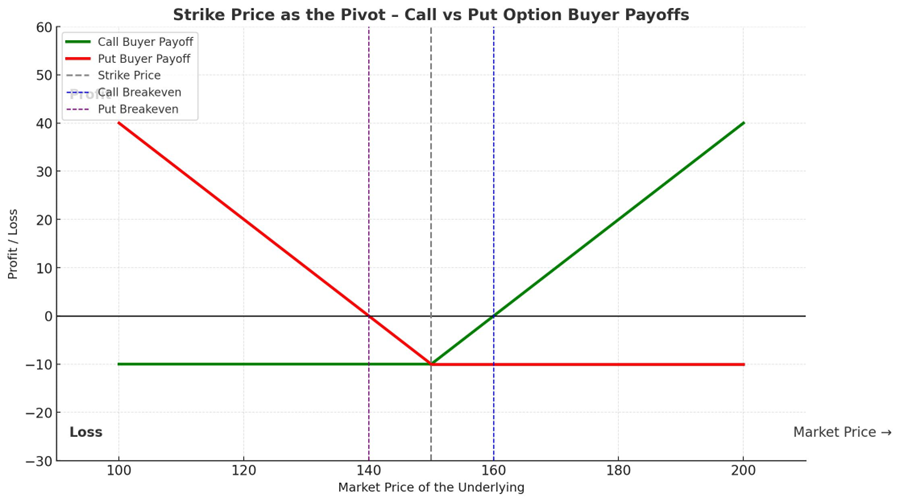
Your profit or loss depends on where the spot price is relative to the strike price:
| Position Type | Market Price vs Strike | Option Status |
|---|---|---|
| Call Option | Above Strike | In the Money (ITM) |
| Call Option | Equal to Strike | At the Money (ATM) |
| Call Option | Below Strike | Out of the Money (OTM) |
| Put Option | Below Strike | In the Money (ITM) |
| Put Option | Equal to Strike | At the Money (ATM) |
| Put Option | Above Strike | Out of the Money (OTM) |
Visual Representation:
How Traders Use Strike Prices
| Scenario | Strategy Suggestion |
|---|---|
| Strongly Bullish | Buy Call at ATM or slightly OTM |
| Slightly Bullish | Buy Call at ATM or ITM |
| Strongly Bearish | Buy Put at ATM or slightly OTM |
| Hedge Long Position | Buy Put at ATM or slightly ITM |
| Income via Option Writing | Choose OTM strikes for safety |
Key Takeaways
- Strike price is pre-decided and does not change.
- Defines whether an option is in-the-money, at-the-money, or out-of-the-money.
- The difference between the strike price and the market price at expiry determines payoff.
- Choosing the right strike is crucial for risk management and profitability.