7. What is the Premium in Options Trading?
In the world of options trading, the premium is the price the option buyer pays to the option seller (writer) for acquiring the right (but not the obligation) to buy or sell the underlying asset at a fixed strike price before or on the expiry date.
It’s a non-refundable cost — think of it like a booking fee or insurance cost. It’s determined by several factors including the market price of the underlying asset, volatility, time left until expiry, and more.
Formula:
Option Premium = Intrinsic Value + Time Value
1. Components of the Premium
| Component | Description |
|---|---|
| Intrinsic Value | Real, measurable value if the option is exercised now |
| Time Value | Additional value based on time left until expiry + market expectations |
Intrinsic Value:
- Call Option: Intrinsic Value = Spot Price – Strike Price (if Spot > Strike)
- Put Option: Intrinsic Value = Strike Price – Spot Price (if Strike > Spot)
Time Value:
- Time left until expiry
- Implied volatility (market’s expectation of future movement)
- Risk-free interest rate (minor influence)
2. Premium Breakdown – Table Format
| Type | Strike Price | Spot Price | Premium | Intrinsic Value | Time Value |
|---|---|---|---|---|---|
| Call | ₹1,500 | ₹1,550 | ₹80 | ₹50 | ₹30 |
| Put | ₹1,500 | ₹1,440 | ₹75 | ₹60 | ₹15 |
| OTM Call | ₹1,600 | ₹1,550 | ₹20 | ₹0 | ₹20 |
| OTM Put | ₹1,400 | ₹1,440 | ₹10 | ₹0 | ₹10 |
3. Visualizing Time Decay in Premium
As expiry nears, the time value of an option erodes (Theta Decay).
Time Decay Curve:
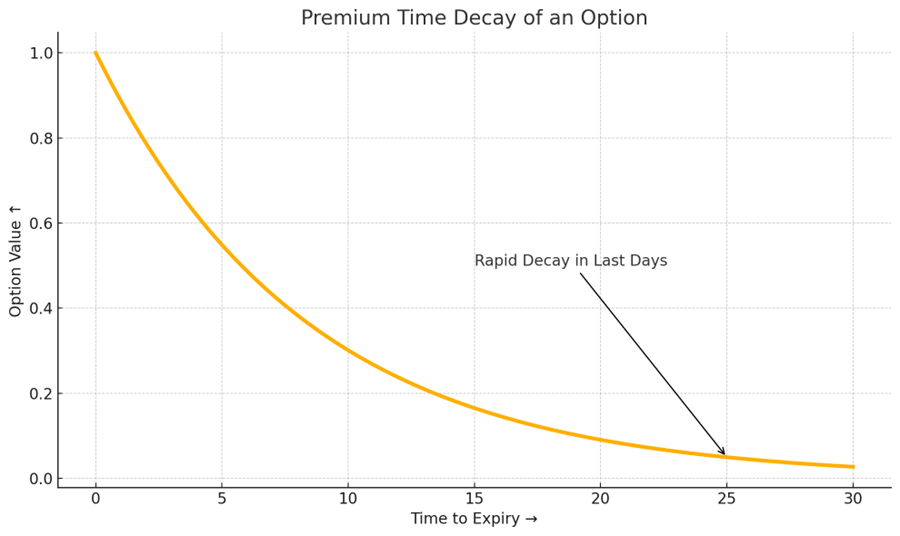
- Time decay accelerates in the last 5–7 days before expiry
- Out-of-the-money options lose all their time value by expiry
4. Real-Life Analogy – Movie Ticket
Think of Premium like a movie ticket:
- You pay ₹60 for a 7 PM show
- If you attend, you enjoy the movie → like exercising a profitable option
- If you skip, the ticket is worthless after 7 PM → like an expired option
- The ticket cost (₹60) = Premium paid
5. Factors That Influence Premium
| Factor | Effect on Premium |
|---|---|
| Underlying Asset Price | Changes the intrinsic value |
| Strike Price | Farther from market price = cheaper |
| Time to Expiry | Longer time = higher time value |
| Volatility | Higher volatility = higher premium |
| Interest Rates | Minor effect (especially long-term options) |
6. Buyer vs Seller Perspective
| Role | Action | Profit/Loss Possibility |
|---|---|---|
| Buyer | Pays premium upfront | Limited loss, unlimited profit |
| Seller | Receives premium | Limited profit, higher risk |
Sellers benefit from time decay Buyers benefit from directional movement
7. Key Takeaways
- The premium is the upfront cost paid by the option buyer to the seller
- It has two parts: intrinsic value + time value
- As expiry nears, time value decays rapidly
- Factors like volatility, time, and strike price affect the premium
- Premiums change in real-time based on market conditions and demand/supply