1. What Is an Option Spread Strategy?
An option spread strategy is a structured trade where a trader buys and sells options of the same type (calls or puts) on the same underlying asset, but with different strike prices and/or expiry dates.
This setup is designed to:
- Reduce the cost of the trade
- Cap risk and reward
- Align the strategy with a specific market outlook (bullish, bearish, or neutral)
It is a more controlled and conservative way to trade options compared to naked calls or puts.
Why Use Spread Strategies?
When you buy a single call or put, you pay a high premium and face unlimited profit or loss potential. Spreads are used to:
- Reduce cost of entry
- Define maximum profit and loss in advance
- Hedge against volatility or time decay
- Target precise market movements
They are ideal for traders who want predictability and discipline in their risk and reward.
Types of Option Spreads
| Spread Type | Components | Market View | Characteristics |
|---|---|---|---|
| Vertical Spread | Same expiry, different strikes | Bullish / Bearish | Most basic and widely used |
| Horizontal (Calendar) | Same strike, different expiry | Neutral / Volatility | Takes advantage of time decay |
| Diagonal Spread | Different strike and expiry | Directional view | Combines time and price movement |
| Credit Spread | Net premium received | Range-bound market | Profits from time decay |
| Debit Spread | Net premium paid | Directional trade | Lower breakeven than single-leg |
Deep Dive: Vertical Spreads
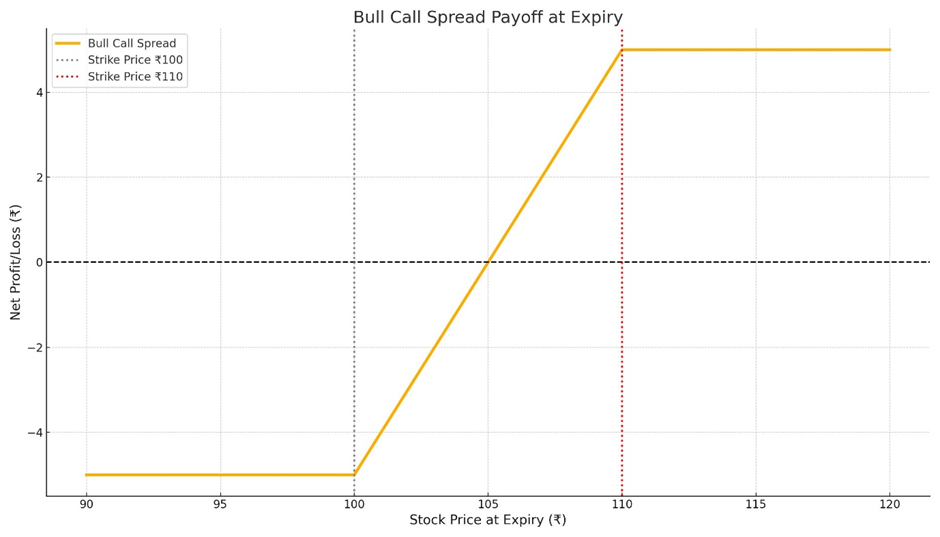
a) Bull Call Spread (Bullish Strategy)
- Buy call at lower strike
- Sell call at higher strike
Example setup:
- Buy 1 Call at ₹100 strike for ₹8 premium
- Sell 1 Call at ₹110 strike for ₹3 premium
- Net cost = ₹8 – ₹3 = ₹5 (this is the maximum possible loss)
Payoff table:
| Stock Price @ Expiry | ₹100 Call (Bought) | ₹110 Call (Sold) | Net P/L |
|---|---|---|---|
| 95 | 0 | 0 | –5 |
| 100 | 0 | 0 | –5 |
| 105 | 5 | 0 | 0 |
| 110 | 10 | 0 | 5 |
| 115 | 15 | 5 | 5 |
Summary:
- Max profit = ₹10 (spread) – ₹5 (premium) = ₹5
- Max loss = ₹5 (net premium paid)
- Breakeven = ₹100 + ₹5 = ₹105
b) Bear Put Spread (Bearish Strategy)
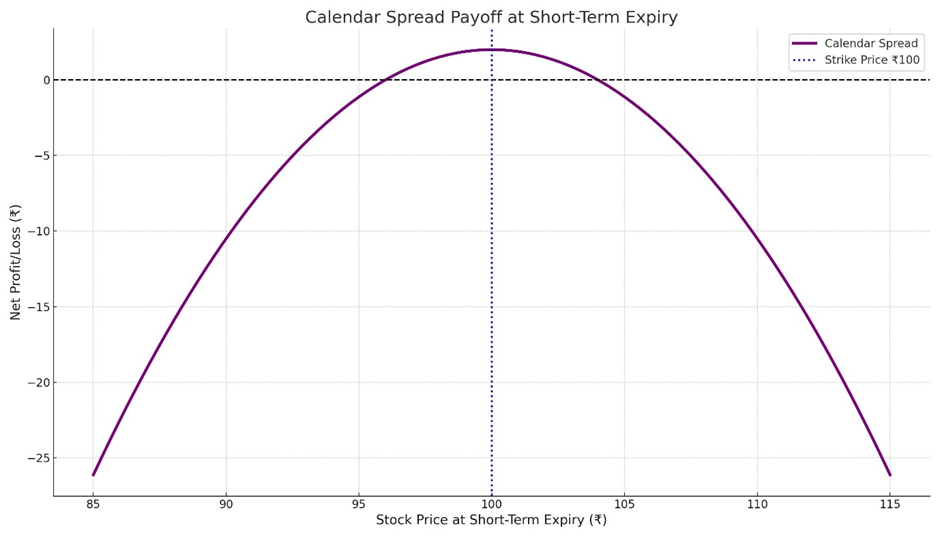
- Buy put at higher strike
- Sell put at lower strike
Example setup:
- Underlying stock trading at ₹110
- Buy ₹110 Put at ₹6 premium
- Sell ₹100 Put at ₹2 premium
- Net premium paid = ₹6 – ₹2 = ₹4
Payoff table:
| Stock Price @ Expiry | ₹110 Put (Buy) | ₹100 Put (Sell) | Net P/L |
|---|---|---|---|
| 115 | 0 | 0 | –4 |
| 110 | 0 | 0 | –4 |
| 105 | 5 | 0 | 1 |
| 100 | 10 | 0 | 6 |
| 95 | 15 | 5 | 6 |
Summary:
- Max profit = ₹10 – ₹4 = ₹6 (occurs at or below ₹100)
- Max loss = ₹4 (net premium paid)
- Breakeven = ₹110 – ₹4 = ₹106
Key points:
- Used when moderately bearish
- Risk limited to premium paid
- Reward capped but higher than risk
- Safer than buying a naked put
Time-Based Spreads
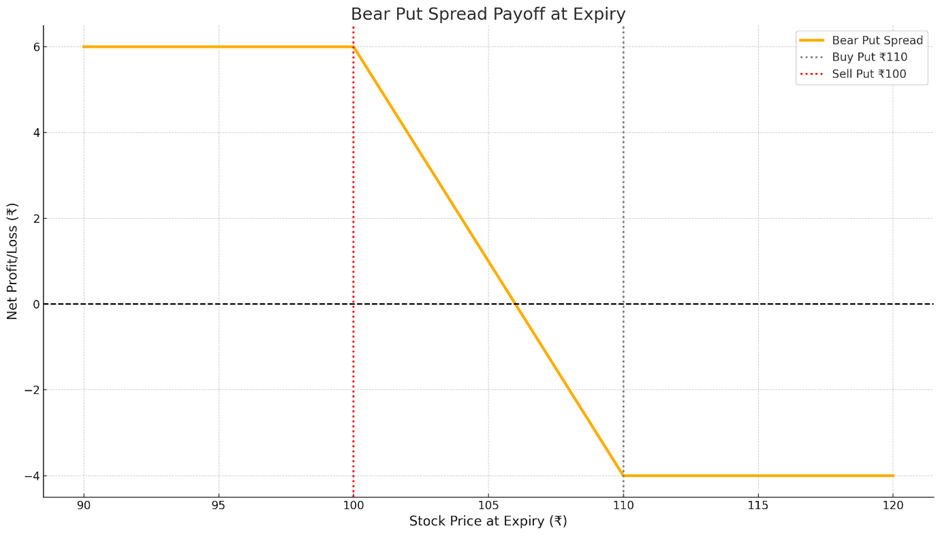
a) Calendar Spread (Neutral or Volatility Strategy)
- Buy long-dated option
- Sell short-dated option at same strike
When to use:
- Expect the underlying to stay near a price in the near term
- Expect volatility to rise in longer-term option
- Want to benefit from time decay in short-term option
Example: Call calendar spread
- Stock XYZ at ₹100
- Buy ₹100 Call (1-month expiry) at ₹10
- Sell ₹100 Call (1-week expiry) at ₹3
- Net cost = ₹10 – ₹3 = ₹7 (maximum loss)
Possible outcomes at short-term expiry:
| Stock Price @ Expiry | Short Call (Sold) | Long Call (Held) | Net Result |
|---|---|---|---|
| 90 | 0 | ~1 | –6 |
| 100 | ~0 | ~9 | +2 |
| 110 | ~10 | ~14 | –3 |
Summary of calendar spread:
| Aspect | Value |
|---|---|
| Max profit | Occurs when price ≈ strike |
| Max loss | Net premium paid (₹7) |
| Breakeven | Slightly above or below strike |
| Ideal market | Neutral to low movement |
| Option type | Can be calls or puts |
Advantages of Spread Strategies
- Lower capital outlay
- Defined risk and reward
- Applicable in all market conditions
- Less emotional trading due to capped risk
- Easier margin requirements than naked selling
Risks and Limitations
- Profits capped
- Multi-leg execution complexity
- Requires monitoring near expiry
- Margin may still be needed (credit spreads)
When Should You Use a Spread?
- When you have a moderate view (not extreme bullish/bearish)
- When you want to limit risk and reduce cost
- When you expect range-bound movement or limited volatility
- When you want to profit from time decay
Summary
| Feature | Naked Option | Spread Strategy |
|---|---|---|
| Cost | High | Lower |
| Risk | Unlimited (selling) | Limited |
| Profit Potential | Unlimited | Capped |
| Complexity | Simple | Moderate |
| Ideal For | Strong view | Controlled outlook |
Key Takeaways
- An option spread is a strategic trade involving buying and selling options together
- Spreads help control risk, reduce premium, and define reward
- Different spreads suit bullish, bearish, or neutral outlooks
- They are ideal for defined-risk setups without extreme exposure