1. What is an Option?
An option is a financial derivative instrument, meaning its value is derived from an underlying asset such as a stock, index, commodity, or currency.
An option gives the buyer the right, but not the obligation, to buy or sell the underlying asset at a pre-decided price (strike price) on or before a specific expiry date.
In return for this right, the buyer pays a premium to the seller (writer) of the option.
Who Uses Options and Why?
The options market attracts various types of participants, each using options to fulfil different objectives. Understanding who uses options and why can help you appreciate their versatility in financial markets.
1. Hedgers – Protect Against Risk
Who They Are:
- Investors, fund managers, businesses, or institutions with exposure to the underlying asset.
Why They Use Options:
- To protect portfolios/assets from adverse price movements without selling the assets themselves.
Example: A mutual fund manager holding ₹100 crore worth of Nifty stocks may buy put options to guard against a potential market decline. If the market crashes, the gain from the put offsets the loss in the portfolio.
2. Speculators – Profit from Price Movements
Who They Are:
- Retail traders, proprietary desks, or short-term investors.
Why They Use Options:
- To profit from upward or downward price movements using relatively small capital with limited risk.
Example: A trader expecting Reliance stock to rise might buy a call option instead of the stock. If the stock rises sharply, the option gives much higher returns due to leverage, while the maximum loss is limited to the premium paid.
3. Arbitrageurs – Exploit Price Differences
Who They Are:
- Professional traders, institutions, or hedge funds.
Why They Use Options:
- To exploit temporary price differences between spot and futures/options markets or between contracts for risk-free/low-risk profit.
Example: If Nifty futures are overpriced compared to the spot index, an arbitrageur may short the futures and buy the basket of Nifty stocks, profiting from convergence at expiry.
Why Are Options So Popular?
Options are a preferred tool for many traders and institutions due to their unique advantages:
- Leverage – Control a large position with small capital. Example: ₹5,000 premium can control stocks worth ₹1,00,000+.
- Defined Risk (for Buyers) – Maximum loss is limited to the premium paid.
- Strategic Flexibility – Can combine in creative ways (spreads, straddles, strangles, etc.) for any market condition.
Real-World Analogy
Think of an option like booking a movie ticket online:
- You pay a booking fee (premium)
- You reserve the right to watch the movie (buy the asset)
- If you don’t go, you lose only the booking fee (premium = only loss)
Key Components of an Option Contract
| Term | Meaning |
|---|---|
| Underlying Asset | The asset the option is based on (e.g., Reliance stock, Nifty index) |
| Strike Price | The price at which the option can be exercised |
| Expiry Date | The last valid date of the contract |
| Premium | The cost paid by the buyer to acquire the option |
| Option Buyer | The one who pays the premium and owns the right |
| Option Seller | The one who receives the premium and has the obligation |
Types of Options
| Type of Option | Buyer’s Right | Buyer’s Outlook | Seller’s Obligation |
|---|---|---|---|
| Call Option | To buy the asset | Bullish (price rise) | To sell the asset if exercised |
| Put Option | To sell the asset | Bearish (price fall) | To buy the asset if exercised |
Basic Example: Call Option
- Underlying: Infosys stock
- Current Market Price: ₹1,500
- Call Option Strike Price: ₹1,550
- Expiry: 1 month
- Premium: ₹20 per share
You buy 1 lot (500 shares). You pay ₹20 × 500 = ₹10,000 as premium.
Case A: Infosys rises to ₹1,600
- Buy at ₹1,550 (strike) → sell at ₹1,600 (market)
- Profit: ₹50 × 500 = ₹25,000
- Net Profit = ₹25,000 – ₹10,000 = ₹15,000
Case B: Infosys stays below ₹1,550
- Do not exercise → expires worthless
- Loss = ₹10,000 (premium paid)
Put Option Example
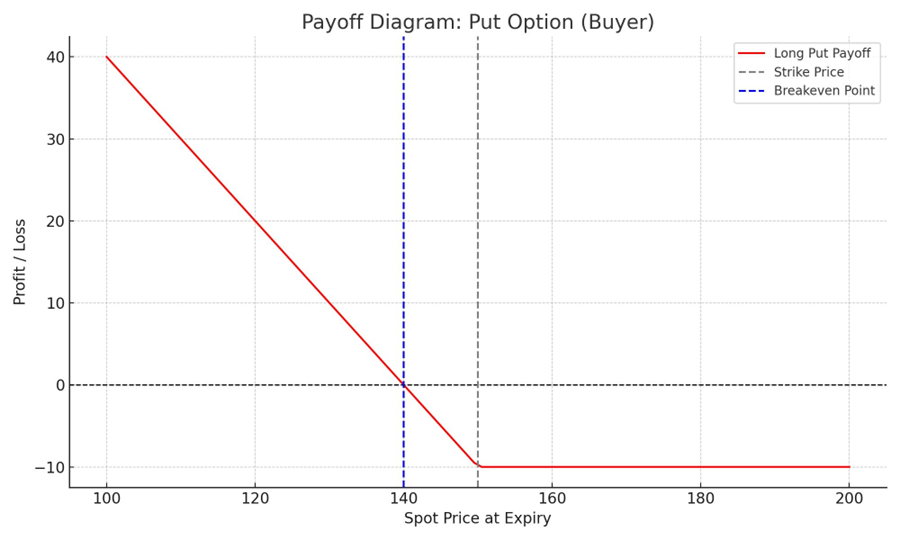
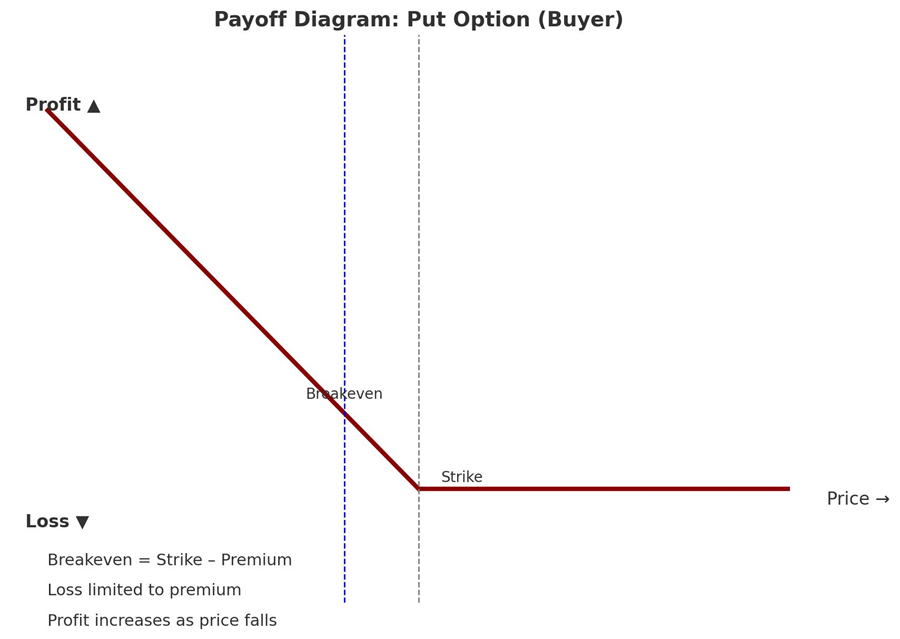
- Strike: ₹1,500
- Spot: ₹1,500
- Premium: ₹30
- Expiry: 1 month
Case A: Stock falls to ₹1,400
- Sell at ₹1,500 (strike), buy at ₹1,400 (market)
- Gain = ₹100
- Net Profit = ₹100 – ₹30 = ₹70 per share
Case B: Stock stays above ₹1,500
- Do not exercise → expires worthless
- Loss = Premium paid
Options vs Futures: Key Differences
| Factor | Options | Futures |
|---|---|---|
| Obligation | Buyer has right, not obligation | Both buyer and seller have obligation |
| Risk (Buyer) | Limited to premium | Unlimited |
| Risk (Seller) | Potentially unlimited | Unlimited |
| Cost | Buyer pays premium upfront | Margin based |
| Flexibility | Can build complex strategies | More linear |
| Settlement | On/Before expiry (depends on type) | Compulsory on expiry |
When to Use an Option?
| Market View | Strategy | Option Type |
|---|---|---|
| Very Bullish | Buy Call | Call Option |
| Very Bearish | Buy Put | Put Option |
| Neutral | Sell options / spreads | Both |
| Uncertain | Use straddles/strangles | Both |
Key Takeaways
- Options are powerful tools, but they require knowledge and control.
- They offer:
- Limited risk, unlimited gain (for buyers)
- Multiple strategic uses
- Income opportunities (for sellers)
- But they also require:
- Market knowledge
- Awareness of expiry & pricing
- Discipline in risk management