2. What are the Two Main Types of Options?
This lesson will walk a learner through the full concept of Call and Put Options, using real-life analogies, detailed examples, tabular comparisons, and visual understanding—ideal for building strong foundational clarity.
Introduction to Options
In the world of financial markets, options are contracts that offer flexibility, strategic control, and limited risk. But to use them effectively, one must first understand the two main types of options:
- Call Options
- Put Options
Each type gives the buyer a specific right—either to buy or sell an asset. These are used in various ways depending on whether a trader expects the market to rise, fall, or remain range-bound.
1. What is a Call Option?
A Call Option gives the buyer the right (not obligation) to buy a specific asset (stock, index, commodity, etc.) at a fixed price (called the strike price) on or before the expiry date.
When to Buy a Call Option:
- You believe the price of an asset will rise.
- You want to profit from upward movement using small capital.
- You want limited loss, unlimited gain.
Example – Buying a Call Option
- Underlying: Infosys
- CMP: ₹1,450
- Strike Price: ₹1,500
- Premium: ₹30
- Lot Size: 300 shares
Scenario A: Stock rises to ₹1,560
- Buy at ₹1,500, Sell at ₹1,560
- Gross Gain = ₹60 × 300 = ₹18,000
- Net Profit = ₹18,000 – ₹9,000 (premium) = ₹9,000
Scenario B: Stock remains below ₹1,500
- Do not exercise.
- Loss = Premium paid = ₹9,000
Key Features of Call Options
| Feature | Call Option Buyer |
|---|---|
| Right | To buy the asset |
| View | Bullish (expecting price to rise) |
| Risk | Limited to premium |
| Reward | Unlimited potential |
| Best Use | Leverage with controlled risk |
2. What is a Put Option?
A Put Option gives the buyer the right (not obligation) to sell the underlying asset at the strike price before or on the expiry date.
When to Buy a Put Option:
- You believe the asset’s price will fall.
- You want to protect a stock portfolio from falling value.
- You want to profit from a bearish outlook.
Example – Buying a Put Option
- Underlying: Tata Steel
- CMP: ₹130
- Strike Price: ₹125
- Premium: ₹4
- Lot Size: 500 shares
Scenario A: Stock falls to ₹118
- Sell at ₹125, Buy back at ₹118
- Gross Profit = ₹7 × 500 = ₹3,500
- Net Profit = ₹3,500 – ₹2,000 (premium) = ₹1,500
Scenario B: Stock remains above ₹125
- Do not exercise.
- Loss = Premium paid = ₹2,000
Key Features of Put Options
| Feature | Put Option Buyer |
|---|---|
| Right | To sell the asset |
| View | Bearish (expecting price to fall) |
| Risk | Limited to premium |
| Reward | High (as prices fall toward zero) |
| Best Use | Hedging or directional bearish bets |
Side-by-Side Comparison Table
| Feature | Call Option | Put Option |
|---|---|---|
| Buyer’s Right | To buy the asset | To sell the asset |
| Seller’s Obligation | Must sell if exercised | Must buy if exercised |
| Used When | Expecting price to rise | Expecting price to fall |
| Profit Potential | Unlimited | Limited but significant |
| Loss Limited To | Premium paid | Premium paid |
| Hedging Use | Lock-in purchase cost | Insure against price drops |
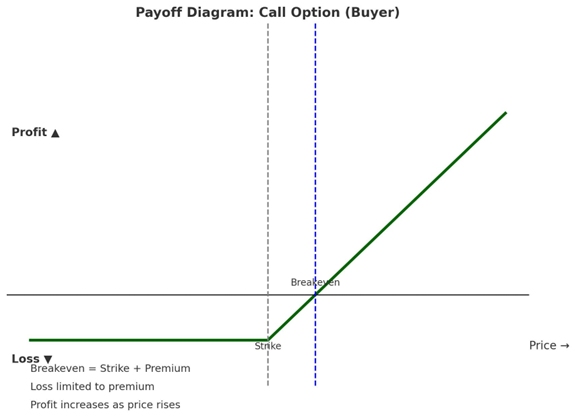
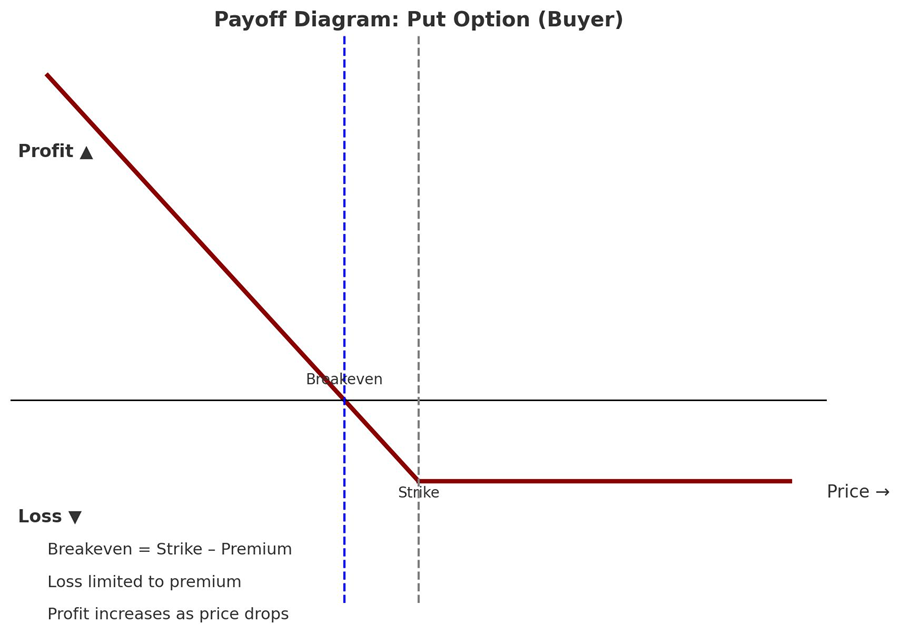
Visual Summary
Key Takeaways
- The Call Option is used when you're bullish, offering unlimited upside with limited downside.
- The Put Option is for bearish scenarios or protection, offering profit if the asset declines.
- Both provide strategic flexibility, hedging capabilities, and controlled risk.
- The buyer has no obligation, making options a risk-defined instrument for any market participant.